Monday, 7 May 2018

Charleston, Charleston...

I suppose there are worse earworms:


We traveled to Charleston in one go directly from St. Augustine.  By we I mean Sam and I.  Reg and Riley rented a car and stayed in a hotel instead of sailing straight for 34 hours.  I think the rough crossing from the Bahamas has scared Reg away for life.


The houses along the waterfront on the way into Charleston were stunning.
The local college sports teams are called the Cougars.  And here I thought I had found the perfect club for me!
This house was being raised from it's foundations presumable to protect from flooding. I wish I had been there on a weekday to watch the work.

We spent two nights in Charleston so I would have time to visit a southern plantation (and go to a farmer's market - strawberries are in season down here!). We chose the McLeod Plantation mostly because the location on Jame's island is a short Uber from the marina.


The cotton plantation was purchased by the McLeod family in the mid 1850s. When the Union army advanced on James' island in 1862, the family was forced to evacuate. They took most of their slaves with them but 10 fled in the night prior to the evacuation to try and reach the union troops and freedom. History is silent on the fate of 9 of them but it is known that one did reach safety and joined the union forces.

With the house empty, the confederate troops used it as a field hospital and headquarters for most of the remainder of the civil war. The north occupied it for a short time right at the tail end.  The part of the history of the south that I was completely unfamiliar with came after the war with the formation of the Freedman's Bureau which was responsible for, among other things, selling small parcels of land to former slaves. The slave who escaped in 1862 and joined the union forces returned to the plantation and purchased land under this program.  Unfortunately the bureau was dismantled when president Johnson (who became president when Lincoln was assassinated) vetoed a bill to renew the charter for the Bureau.  With the dismantling of the Bureau, the introduction of Black Codes in the south, and the rise of the KKK, any advances made were rolled back and the plantation land returned to the McLeod family. One wonders what things would have been like had Lincoln not been assassinated.

The slave cabins on the property eventually became homes for share croppers and were inhabited until 1990 when the last of the McLeod family died at the age of 104.  Rent at the time for the small one room cabins was $26 per month and included electricity but no running water.  One cabin was inhabited by 14 members of one family!


The original front facade of the house, it became the back door when land was sold off for a golf course and a road cut through the rear of the property making that the front entrance.


The font of the McLeod Plantation house.  This fancy columns and portico were added in the 1920s as it was deemed not grand enough when the back door became the front door.


A three hundred year old oak tree near the house. She was gorgeous.


A row of slave cabins.  I believe there were once 23 of them.  6 or 7 remain.


Friday, 4 May 2018

St. Augustine

We are not big fans of Florida.  The place is littered with abandoned boat (often making for crowded anchorages) and the boaters fly past us with large wakes that send objects flying in the boat if we haven't stowed everything.  St. Augustine is the exception and well worth a visit.  

It is the oldest continuously occupied city in the US and has a fascinating history. The whole area was "discovered" by Ponce de Leon in the early 1500s (unfortunately we, like he, did not find the fountain of youth).  He claimed the land for Spain.  Of course the French didn't think that was a good idea and by the mid 1500s were also settling in the area. The Spanish began to build fortifications and the town of St. Augustine was born. Poor St. Augustine had a rough few hundred years after that.  In 1566 the local native tribes burned it to the ground. They couldn't hold the town, and the Spanish rebuilt. In 1586 Sir Francis Drake attacked and burned it to the ground.  He couldn't hold the town and the Spanish rebuilt. After another raid by another Brit in 1666 the Spanish finally decided that perhaps a more robust structure was in order and over the next 25 years or so they built a stone fort which still stands.  

In 1763,  as part of the treaty ending the 7 years war, Spain gave Florida to the British in exchange for Cuba (much like trading baseball cards). Shortly after that the American Revolution began.  Spain sides with the Americans and as part of the treaty that ends the Revolution in 1783, Britain trades their Florida territories back to Spain in exchange for the Bahamas (unlike baseball cards, apparently trade-backs are allowed in international treaties). The Americans are not pleased about this and fight with the Spanish for the next 40 years or so.  The Seminole, the French, and some Haitians all get involved.  Finally in  1819 Spain sells their territory in Florida to the Americans for 5 million dollars.

With all this history, tours of the town and the fort are well worth the time.

Now, for the photos:

This was in my St. Augustine photo folder.  Because I've been so lazy about blogging I no longer have a clue when or where it was taken or even if it is a sunrise or sunset (likely a sunset since I'm rarely up that early) but isn't it pretty?


On the way into St. Augustine - another damaged and abandoned sailboat. I'm amazed some level of government can't get the owners to remove them.


We had our first meal out since returning to the US in St. Augustine. After the lack of fresh produce in the Bahamas we were all overwhelmed by the choices.


Just out riding around town with a parrot on the handlebars as one does.

Magnolia Avenue.  They are actually 100 year-old oak trees - the magnolias all died in a cold snap.

After looking like scruffy pirates in the Bahamas the boys went to an old fashioned barber shop to clean up which included neck shaves and scalp vacuums:


The plaque with the context wasn't installed yet. I'm curious what it will say.


Souvenir shopping (no, we didn't buy it).  They also had a t-shirt depicting Abraham Lincoln riding a bear holding the US Constitution and a rifle.


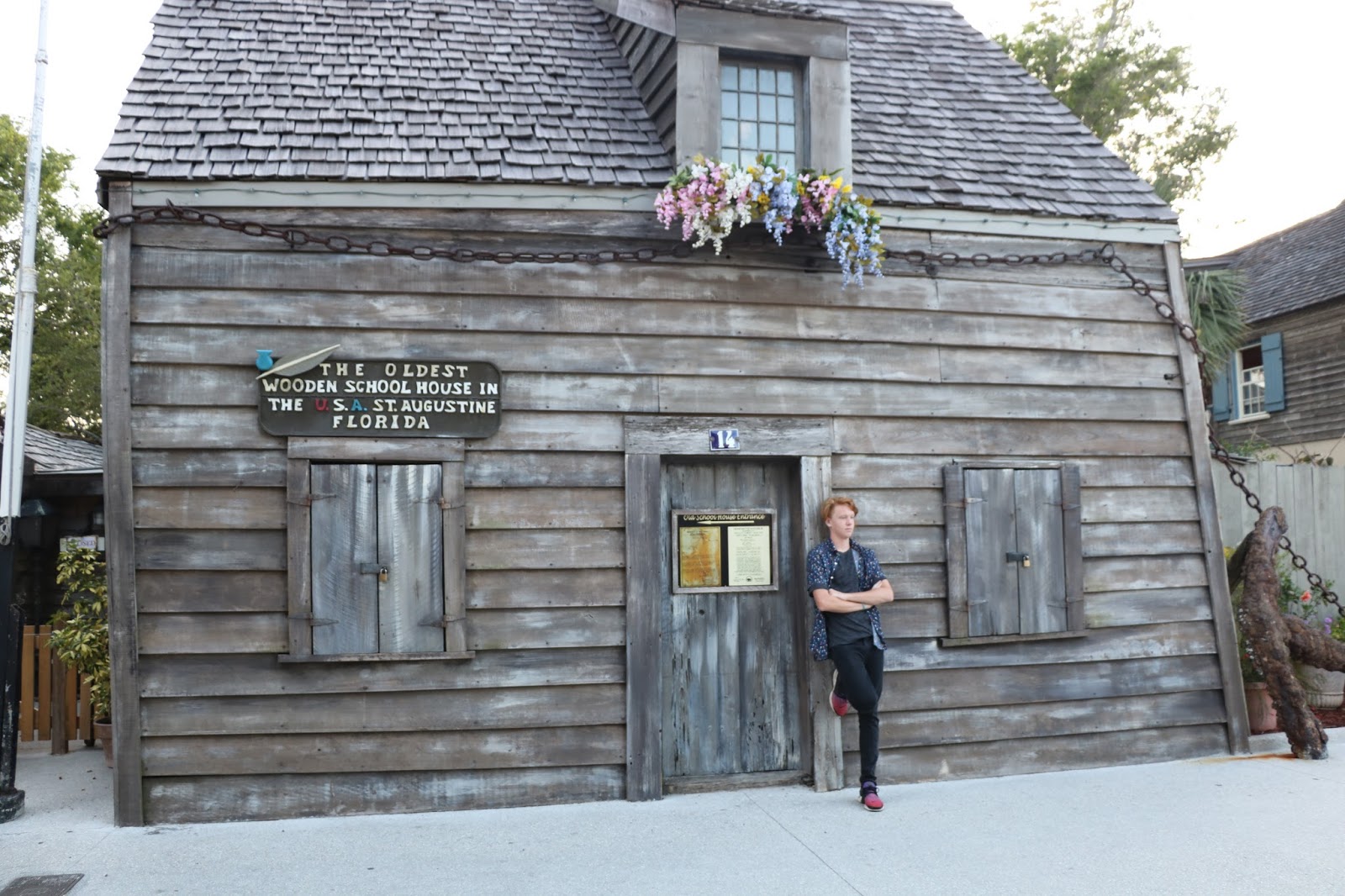
The oldest wooden schoolhouse in the US. The closest Riley has come to attending school since last June.  

One of the jewels of St. Augustine is Flagler College built as a 5 star hotel by one of the founders of Standard Oil.  It opened in 1888 and became a college in 1968.


Sundial in the courtyard. The frogs tell the time and the turtles the season.

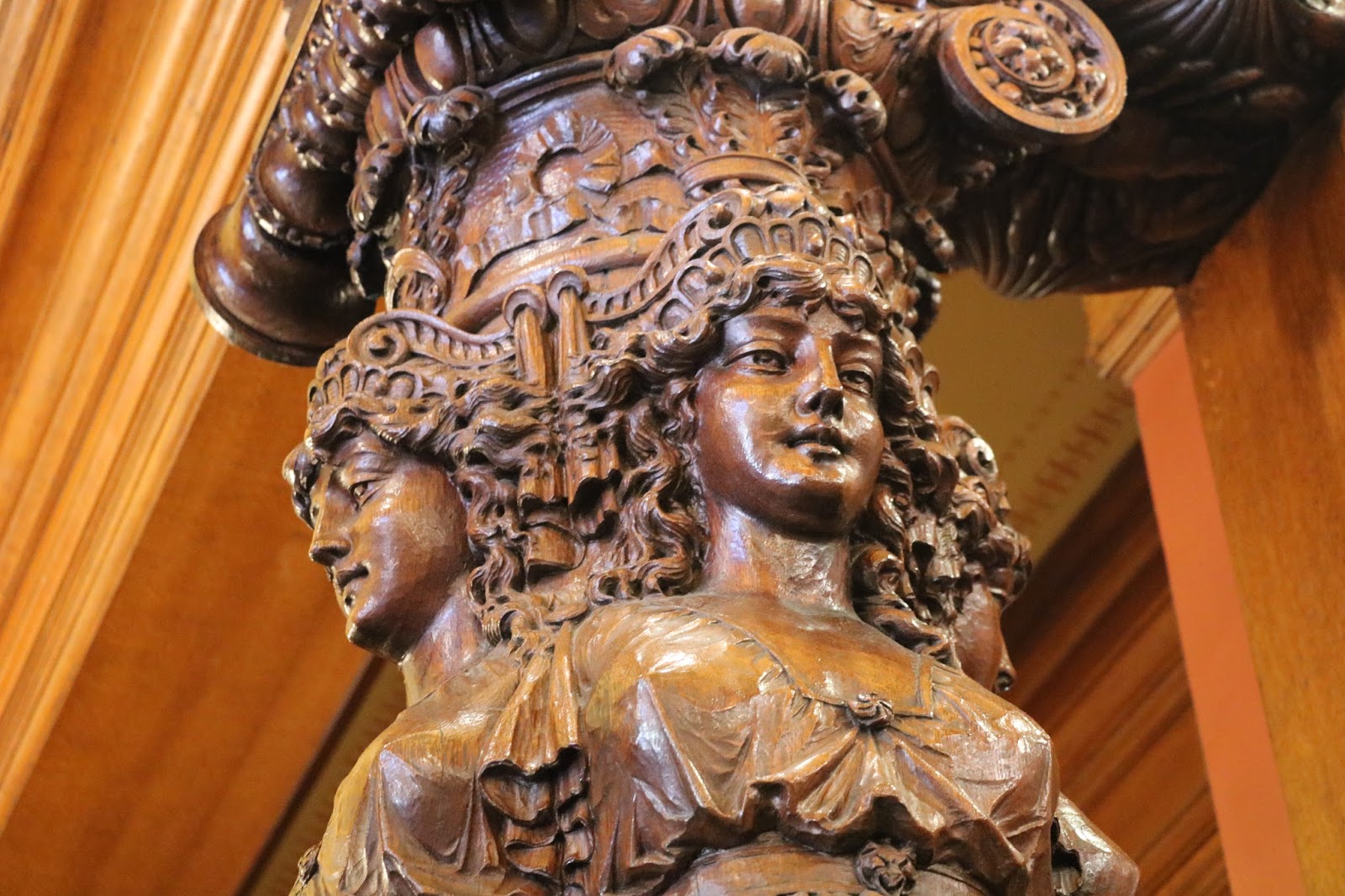
The lobby:


The dining hall complete with the larges installation of Tiffany glass in the world.  A little fancier than those at the University of Waterloo:


The fort, Castillo de San Marcos:


Not sure how they can paint this prat as a good guy


Can you imagine a military these days going to so much effort and expense to make their killing machines so beautiful?


The civil engineering exhibits are always the best part of any historical tour


The fort was built with coquina quarried from nearby Anastasia Island. Coquina is a limestone of broken shells.  It is so elastic that the fort could apparently withstand a cannon ball strike at close range. 


The St. Augustine mooring field as seen from the fort. Can you spot Binary?


x

Friday, 27 April 2018

Kennedy Space Center

We spent two nights at a marina in Cape Canaveral so we could visit the Kennedy Space Center.  We went in not really knowing what to expect but this family of nerds came away very happy with the trip. Sam and I in particular were inspired by the experience.  Sam because he is on the cusp of starting his engineering education and me because I am in the throes of a midlife engineering career crisis. To be able to work on a project on the cutting edge of technology, where every problem is a new one that has never been solved before must be exhilarating. One exhibit described the engineers and scientists they need to supporr a Mars mission - apparently environmental engineers and hydrogeologists are needed to figure out where all the water on Mars went to. I could do that.


The Canadarm!  The US made a whole shuttle but we made an arm, dammit.

Seeing the actual shuttle was strange.  It is smaller than I thought and a little beat up.


They still find a way to play video games.

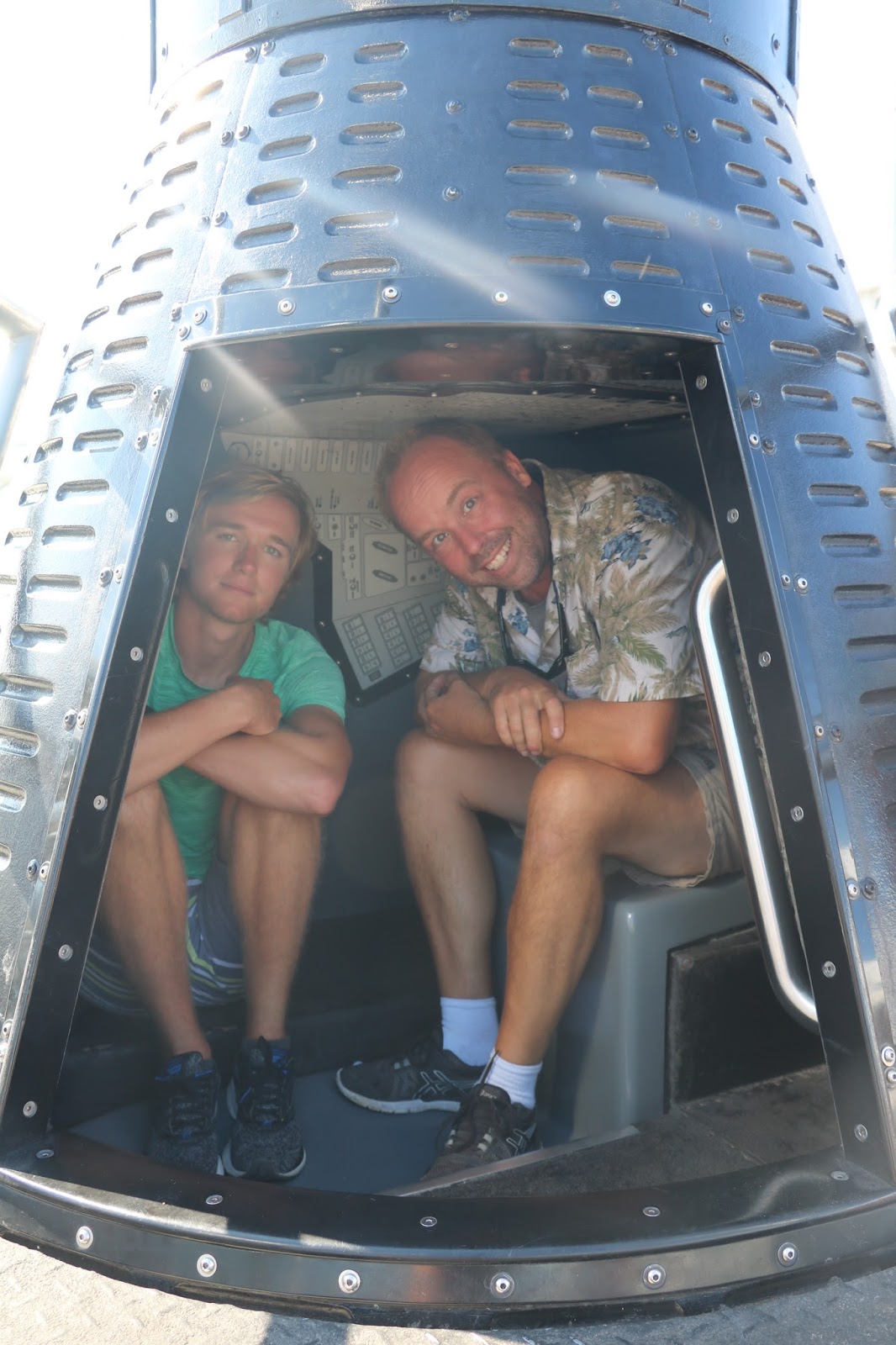
I loved looking at the technology behind the Mercury missions.  So outdated compared to what we all carry in our pockets today yet it accomplished amazing things.


The nerds who wore these coats are the real heros of NASA!


The original countdown clock.

Wednesday, 25 April 2018

I would sail 5000 miles, and I would sail 5000 more...


Edit (5/21/18)- Ooops I had a mistake in my calculation.  We only hit 4000 nautical miles on our crossing back to the US.  I'll update again when I actually hit the big one.

Edit (6/5/18) I hit 5000 miles on the trip to Solomons, MD

My apologies to The Proclaimers (above) but I had to modify their lyric and make a special post for this as I didn't want it to be buried in another post.  On our crossing from Bimini to Cape Canaveral we hit 5000 nautical miles since leaving Hamilton in July. For sailors, 5000 nautical miles is a milestone.  Sailors have traditions of marking voyages with tattoos - one of those traditions is a swallow for every 5000 miles. I will definitely be making an appointment when I get home.

Bonus trivia: the song I'm Gonna Be (500 miles) was the first song that Reg and I danced to on our first date.

Bye Bye Bahamas

Our last week in the Bahamas was a whirlwind.  We had a plan to work our way up Eleuthera and then cross to the Abacos and make our way to the most north-western point in the Bahamas before jumping back to the US.  That plan changed when we were in Spanish Wells with a forecast full of north wind which would make the crossing to Abaco miserable.  We decided to abandon that idea and head west back to the Berry islands then Bimini.

Over the next few days we traveled almost 340 nautical miles and landed in Cape Canaveral, Florida. Our original plan was to travel much further north and land in St. Augustine.  Mother Nature, Poseidon, and Neptune conspired against us with thunderstorms and strong north winds which had us turn in early.  The thunderstorms while unnerving weren't actually the scariest part.  That award goes to the stronger than predicted north winds which turn up horrible waves when they meet the gulf stream running in the opposite direction.  Sam and I were game for continuing as the conditions were improving by the time we turned west, but Reg was decidedly green and Riley decidedly bored.

Our last glimpse of the beautiful waters of the Bahamas

A storm approaches on our crossing back to the US.
Our sails came down approximately 30 seconds after I took this shot.

In the morning after the nasty weather the sun came out and a pod
of 17 dolphins joined us.  We turned off the engine and spent a good
10 minutes watching them.


Thursday, 19 April 2018

Governor's Harbour

Heading north from Rock Sound our next stop was Governor's Harbour, location of the Bahamas' first parliament in 1746.  Given that history, the town had quite a different architectural feel than other places in the Bahamas.


Many of the houses had pineapple detailing in the shutters or fences.  Pineapples were a valuable cash crop on Eleuthera until the US started getting them from Hawaii.

We stopped in at this gift shop . I wonder what happened to prompt this sign.

  
One thing I love about cruising is all the sailors helping each other out.  This guy's dingy was left high and dry when the tide went out.